Share
Minimum Wage in Bulgaria in 2025: Current Level, Recent Evolution and Outlook
28.11.2025
2 min
The minimum wage in Bulgaria continues to play a central role in wage-setting and labour market policies. It affects a significant segment of the workforce and remains a key reference point for both employers and employees. In 2025, Bulgaria implemented another substantial increase, reflecting economic pressures, rising living costs and the country’s gradual alignment with European wage-adequacy standards.
1. What is the minimum wage in 2025 and to whom it applies
As of 1 January 2025, Bulgaria’s statutory minimum monthly wage is BGN 1,077 (approximately €550). This level applies to all full-time employees working under standard labour contracts. The minimum hourly wage is BGN 6.49 (around €3.30) based on an eight-hour workday and a standard workmonth.
The minimum wage establishes the lowest lawful baseline for remuneration in Bulgaria and does not include bonuses, additional payments or sector-specific allowances. It is defined through a government decree and is binding across all sectors unless special provisions apply.
2. How the minimum wage evolved in recent years (2022–2025)
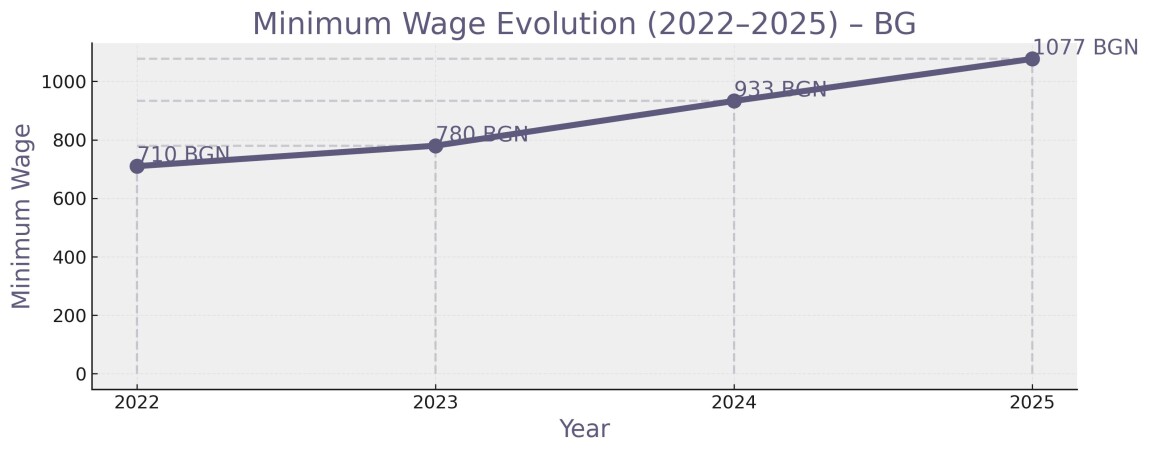
Between 2022 and 2025, Bulgaria recorded steady and significant increases in its minimum wage. In 2022, the minimum was BGN 710 (approx. €363). It rose to BGN 780 (approx. €400) in 2023, then to BGN 933 (approx. €480) in 2024. The jump to BGN 1,077 (€550) in 2025 represents an increase of about 15.4% year-on-year, one of the more pronounced adjustments in recent years.
These increases were driven by inflation, rising living costs and the government’s attempt to keep minimum wages closer to average earnings. Bulgaria’s legislation requires annual adjustments, after consultations among unions, employer organisations and the government.
3. What the 2025 minimum wage means in practice (gross level, purchasing power, comparison)
The 2025 minimum wage of BGN 1,077 (€550) remains below Bulgaria’s average monthly gross wage, which is estimated at around BGN 2,443 (roughly €1,245) at the beginning of 2025. Despite this gap, the increase provides meaningful additional income for workers at the lower end of the wage spectrum.
In terms of purchasing power, the raise helps offset part of the inflation accumulated over the past years. However, its real impact varies across regions, particularly given the significant differences in living costs between urban centres such as Sofia and smaller cities or rural areas.
4. The regulatory context and how the minimum wage is determined
Bulgaria determines its minimum wage annually through a decree issued by the Council of Ministers, following structured consultations through the national tripartite dialogue. Recent changes in Bulgarian legislation require that the minimum wage be linked to half of the national average gross wage, calculated over a designated period. This creates a more transparent and predictable mechanism for wage adjustments, reducing ad-hoc political influence.
5. Sector-specific considerations (if any)
The statutory minimum wage of BGN 1,077 (€550) applies broadly across all economic sectors. At national level, Bulgaria does not currently maintain sector-wide higher statutory minimum wages comparable to those found in some other EU countries. However, reduced minimum levels may apply in cases of apprenticeship or vocational-training contracts, where lower pay during the training period is legally permitted. Outside of these exceptions, the national minimum wage serves as the universal baseline.
Conclusions
Bulgaria’s 2025 increase to BGN 1,077 (€550) reflects the country’s continued efforts to strengthen minimum incomes and address rising living costs. For employees, the new level provides noticeable financial relief, although it still remains significantly below the national average wage. For employers, the higher minimum wage brings increased labour costs, requiring budget adjustments or productivity improvements. With a clearer, more transparent mechanism now governing minimum-wage updates, 2025 represents another step toward a more predictable wage-setting framework in Bulgaria. If current trends persist, further
Share
What I read is worth it:
Article written by:
 wherewework.bg
Comments
0 comments
No comments! Be the first to comment on this article!

Access your account and add your comment
HR Metrics


Subscribe to the Newsletter
Read articles of interest from wherewework.bg contributors
