Share
What public holidays do we have in 2026?
14.11.2025
3 min
December is almost here, and we are preparing for the upcoming New Year celebrations. Beyond the joy of spending time with loved ones, the beginning of the new year also brings good news for everyone on the labor market. The year 2026 will offer numerous excellent opportunities for rest and mini-vacations: in addition to weekends, employees in Bulgaria will have several official public holidays available, which, with a bit of planning, can be used for relaxation or short trips.
In this article, we will look at which are the official public holidays in Bulgaria in 2026, how they are distributed (how many fall on weekdays and how many on weekends), and we will offer several practical tips on how to optimize them for successful mini-vacations.
Public Holidays in 2026
Here is the full list of official public holidays in Bulgaria for 2026, according to the official calendar. These include both fixed dates (national and religious holidays) and movable ones, such as Orthodox Easter, calculated according to the Eastern tradition.
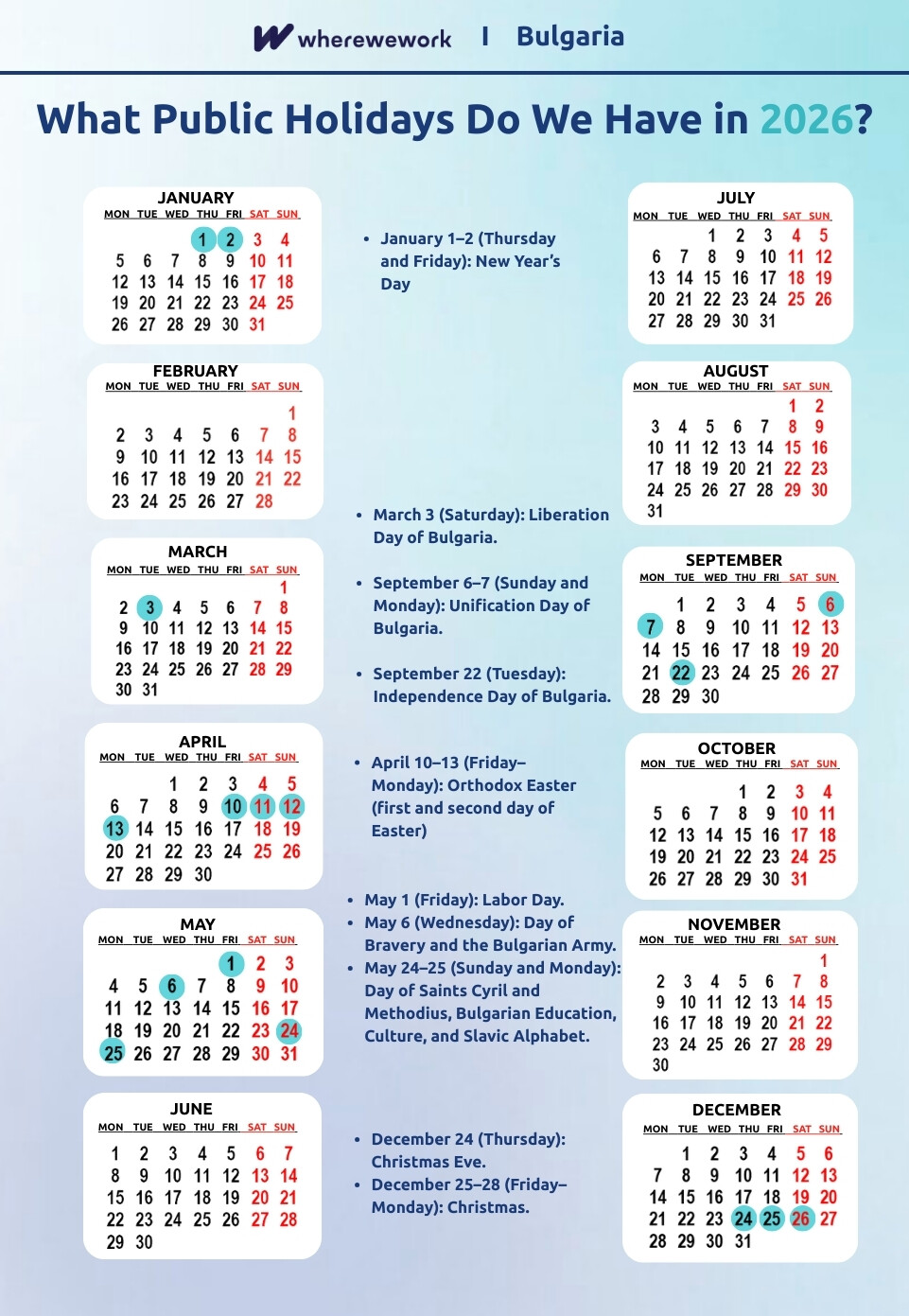
- January 1–2 (Thursday and Friday): New Year’s Day – a strong start to the year.
- March 3 (Saturday): Liberation Day of Bulgaria.
- April 10–13 (Friday–Monday): Orthodox Easter (first and second day of Easter) – two days of celebration.
- May 1 (Friday): Labor Day.
- May 6 (Wednesday): Day of Bravery and the Bulgarian Army.
- May 24–25 (Sunday and Monday): Day of Saints Cyril and Methodius, Bulgarian Education, Culture, and Slavic Alphabet.
- September 6–7 (Sunday and Monday): Unification Day of Bulgaria.
- September 22 (Tuesday): Independence Day of Bulgaria.
- December 24 (Thursday): Christmas Eve.
- December 25–28 (Friday–Monday): Christmas.
Keep in mind that these days are non-working days for most employees, except for essential sectors (such as healthcare or the hospitality industry), where compensation is provided.
Attention! If you work in one of these sectors, you are entitled to double pay or compensation with additional days off.
Legal holidays, weekend overlaps and mini-vacations
One thing is clear: 2026 is a generous year, with a total of 15 official public holidays.
Overlaps and mini-vacations: The New Year comes with several fortunate overlaps, where statutory holidays merge with weekends, automatically creating mini-vacations for people on the labor market:
- New Year: January 1–2 (Thursday and Friday) + weekend = 4 consecutive days off.
- Easter: April 10–13 (Friday–Monday) = a 4-day extended weekend (including Saturday and Sunday).
- Labor Day: May 1 (Friday) + weekend = 3 consecutive days off.
- Day of Saints Cyril and Methodius: May 24–25 (Sunday and Monday) – ideal for bridging with Thursday.
- Unification and Independence Days: September 6–7 (Sunday and Monday) and September 22 (Tuesday) – close to each other, with strong potential for mini-vacations.
- Christmas: December 24–28 (Thursday–Monday) = 5 days off including the weekend.
Other celebrations worth noting?
Besides official public holidays, keep in mind events such as Baba Marta (March 1, unofficial) or various cultural festivals. These are not officially non-working days, but they can serve as an excuse for short getaways.
Overall, these overlaps can generate more than 20 actual days off if combined with a minimal number of vacation days. Compared to 2025, 2026 is more employee-friendly, with fewer “lost” holidays falling on weekends.
How to optimise your public holidays for mini-vacations
- Plan ahead
Identify holidays that fall on Thursday, Friday, or Monday, and book transportation and accommodation in advance.
Example: January 1 (Thursday) → weekend + holiday = 4 consecutive days. - Create bridges
If a holiday falls on Tuesday or Wednesday, you can take Monday or Friday off to create a longer vacation using just one additional vacation day.
Example: May 6 (Wednesday), Day of Bravery → take Tuesday, May 5, off → 4 consecutive days. - Combine public holidays with annual leave
If you have paid vacation days, try adding them before or after public holidays to extend your rest period without using many days. - Pay attention to peak periods
During popular periods (Easter, May 1, May 24), demand for accommodation and transportation increases—book early to get better prices. - Plan diversely
- Mini city break: For holidays falling on Thursday/Friday or Monday, you can visit a Bulgarian city or take a short flight abroad.
- Extended stay: If you can take 2–3 extra vacation days, you can turn public holidays into a week-long vacation.
- Check your employer’s policies
If you work in 24/7 operations or shifts, make sure you know how public holidays are compensated (double pay, compensatory day off, etc.). - Also consider school holidays
If you have children, plan mini-vacations around school breaks, which in 2026 coincide with holidays such as Easter, May 24, and Christmas. This way, you can spend more time together without using too many vacation days. Spring or winter breaks can easily be extended with public holidays—perfect for a mountain getaway or a family city break.
Conclusion
2026 promises a better balance between work and relaxation. With 15 official public holidays, many of them falling midweek, you have every opportunity to turn weekends into mini-vacations. Whether you are planning a spontaneous city break, a mountain trip, or simply a few relaxing days at home with family, the key is early planning.
Prepare your calendar starting in January and make 2026 the year you work smart and truly rest.
Share
What I read is worth it:
Read all the articles about
StatisticsArticle written by:
 wherewework.bg

Comments
0 comments
No comments! Be the first to comment on this article!

Access your account and add your comment
Statistics


Subscribe to the Newsletter
Read articles of interest from wherewework.bg contributors
